
Conference papers and oral presentations
CIPM STG-CENV, 2024, France | HRMS, 2024, Italy | IMEKO 2024, Germany | EMN-COO AGM, 2024, France | ICOLS, 2025, Italy
Coordinated interlaboratory comparisons of CO line intensities: towards primary spectroscopic measurements of the amount of gas and spectroscopic reference data for high accuracy remote sensing applications
1st CIPM STG-CENV Stakeholder meeting, September 2024, BIPM France
Project partner UMK on behalf of the CCQM-GAWG Task Group on Advanced Spectroscopy (TGAS) has presented the interlaboratory comparisons of CO line intensities at the 1st CIPM STG-CENV Stakeholder meeting at BIPM.
https://bipm-cenv2024.org/program/
The recorded talk can be found at:
Early results of the EURAMET Metrology Partnership project "22IEM03 PriSpecTemp": Primary Spectrometric Thermometry for Gases
1st CIPM STG-CENV Stakeholder meeting, September 2024, BIPM France
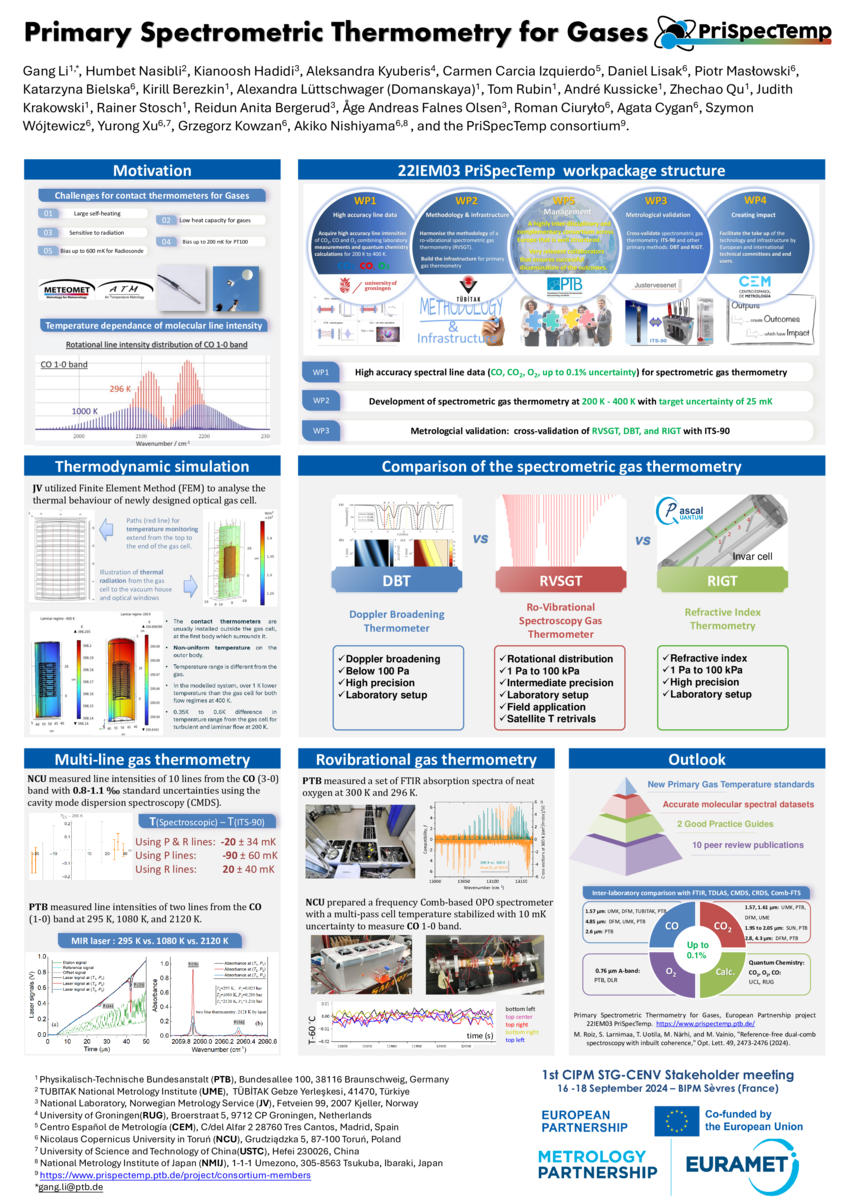
Project coordinator Dr. Gang Li on hehalf of the consortium has presented the early results of the PriSpecTemp project at the 1st CIPM STG-CENV Stakeholder meeting at BIPM.
https://bipm-cenv2024.org/partners/
Abstract:
Accurate air temperature measurements are critical for climate change monitoring and evidence-based policymaking for early mitigation/adaptation planning. Spectrometric thermometry overcomes several practical challenges posed by contact thermometry in air. The EURAMET PriSpecTemp project [1] integrates knowledge and infrastructure across the EU to improve, standardise and implement novel, non-contact methods including primary ro-vibrational spectroscopic thermometry a target uncertainty of 10 mK over a temperature range of 200 – 400 K. Selected early results of the project will be presented:
JV utilized Finite Element Method (FEM) to analyse the thermal behaviour of newly designed optical gas cell. we have investigated the impact of gas pressure, design of the optical windows, thermal radiation, gas pressure and the flow regime inside the heat exchanger on the temperature gradient within the spectroscopic gas cells [2]. The results of the FEM analysis highlight the significance of the design of optical windows, including the size and isolation, in maintaining gas thermodynamic stability and homogeneity.
NCU measured line intensities of 10 lines from the CO (3-0) band with 0.8-1.1 ‰ standard uncertainties Using the cavity mode dispersion spectroscopy (CMDS). Comparison between several laboratories (CCQM-P229 pilot study [3]) led to the most accurate reference line intensities and sub-permille agreement between mean experimental and ab initio data. We tested these datasets as a reference for rovibrational thermometry at 296 K, where we achieved a -20 mK mean difference with standard uncertainty of 34 mK between this optical measurement and the gas cell temperature using SPRTs.
NCU prepared a frequency comb-based OPO spectrometer with a multi-pass cell temperature stabilized with 10 mK uncertainty for the CO (1-0) band line intensity measurements [4].
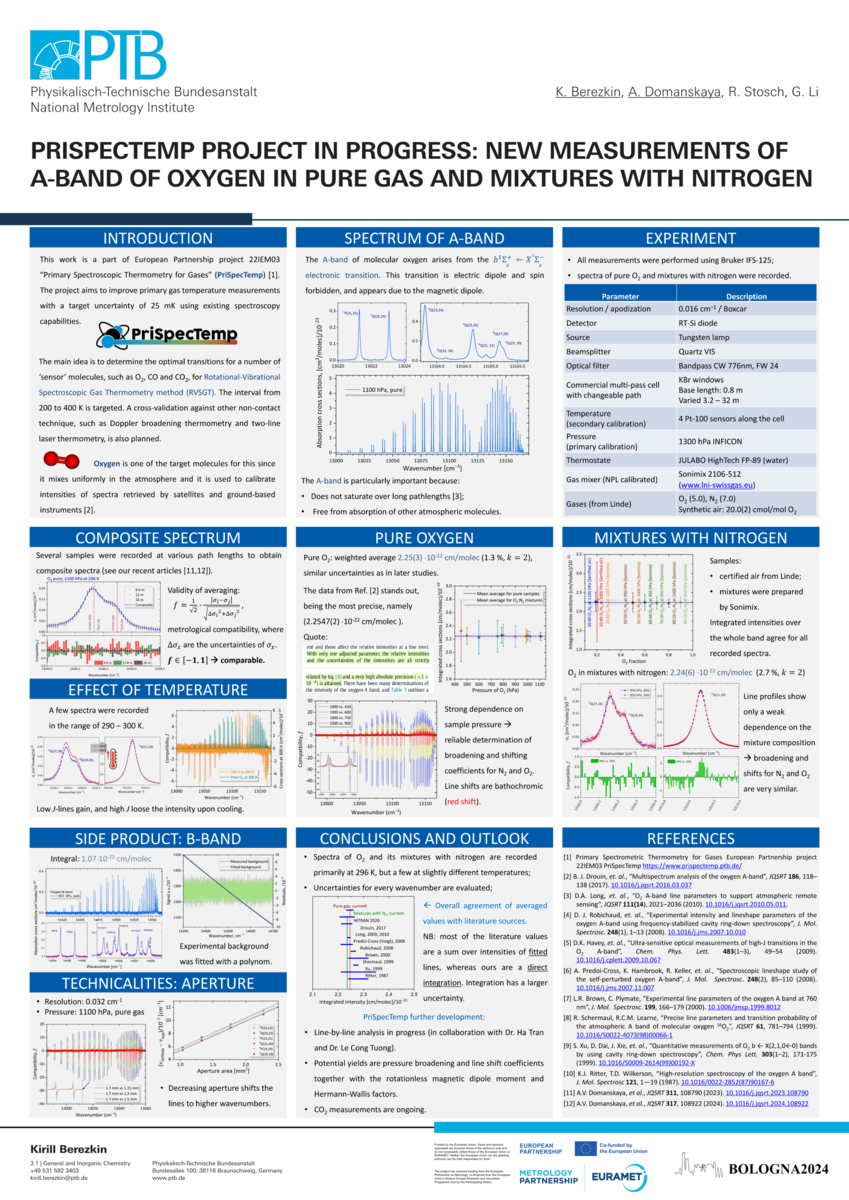
PTB department 3.1 measured a set of absorption spectra of neat oxygen and its mixtures with nitrogen in the pressure range between 450 hPa to 1100 hPa. In a few instances, we followed a similar procedure, used in our recent publications [5] and generated composite spectra from the measurements of the same sample at different pathlengths.
PTB working group 7.55 used TLAS (tunable laser absorption spectroscopy) to measure CO absorption line intensities at 4.6 µm. The traceability of the temperature and pressure determination is particularly important here, as all calibrations are carried out directly at the PTB on primary standards with lowest uncertainties.
PTB working group 3.34 investigated temperature homogeneity in the gas cell and its effects on spectroscopic gas temperature measurements using an optical gas cell. Robust uncertainty analysis was carried out.
PriSpecTemp project in progress: new measurements of A-Band of oxygen in pure gas and mixtures with nitrogen
International Conference on High-Resolution Molecular Spectroscopy (HRMS), September 2024, Italy
PTB presented its recent result on O2 A band spectroscopy at the 27th HRMS Conference in Bologna.
https://eventi.unibo.it/hrms-2024-bologna
The oxygen A-band does not overlap with other atmospheric species, it is also very weak and do not saturate when measured over long pathlengths [1].Oxygen is uniformely distributed in the Earth atmosphere hence its absorbance it very useful for intensitiy calibrations in the spectra, recorded by satellite and ground-based instruments in very different atmospheric conditions [2]. Knowledge of the band structure, intensities and collisional parameters is absolutely important, but remains a challenge for both, theoretical and experimental investigations.
Within the frame of PriSpecTemp project [3], a set of absorption spectra of neat oxygen and its mixtures with nitrogen were recorded in the pressure range between 450 to 1100 hPa. Experimental parameters, such as pressure, temperature and path were calibrated and traceable. Extensive uncertainty evaluation for every wavenumber in every spectrum was performed. In a few intances we followed a similar procedure, used in our recent publications [4] and generated composite spectra from the measurements of the same sample at different pathlengths. The integrated absorption cross sections show a congruence with previous studies (see Figure). Line-by-line fits and analysis of individual parameters are ongoing.
This work is published in the PTB-OAR: https://oar.ptb.de/resources/show/10.7795/810.20240911A
[1] D.A. Long et al. JQSRT 111(14), 2021-2036 (2010). Doi: 10.1016/j.jqsrt.2010.05.011; [2] B. J. Drouin et al. JQSRT 186, 118-138 (2017). Doi: 10.1016/j.jqsrt.2016.03.037; [3] EMPIR project “Primary Spectrometric Thermometry for Gases ” (PriSpecTemp); https://www.prispectemp.ptb.de/home; [4] A. V. Domanskaya JQSRT 317, 108922 (2024), doi: 10.1016/j.jqsrt.2024.108922, JQSRT 311, 108790 (2023), doi: 10.1016/j.jqsrt.2023.108790.
FEM ANALYSIS OF THERMAL PROPERTIES OF AN OPTICAL GAS CELL FOR RO-VIBRATIONAL SPECTROSCOPIC GAS THERMOMETRY (RVSGT)
IMEKO 2024 XXIV World Congress, August 2024, Germany
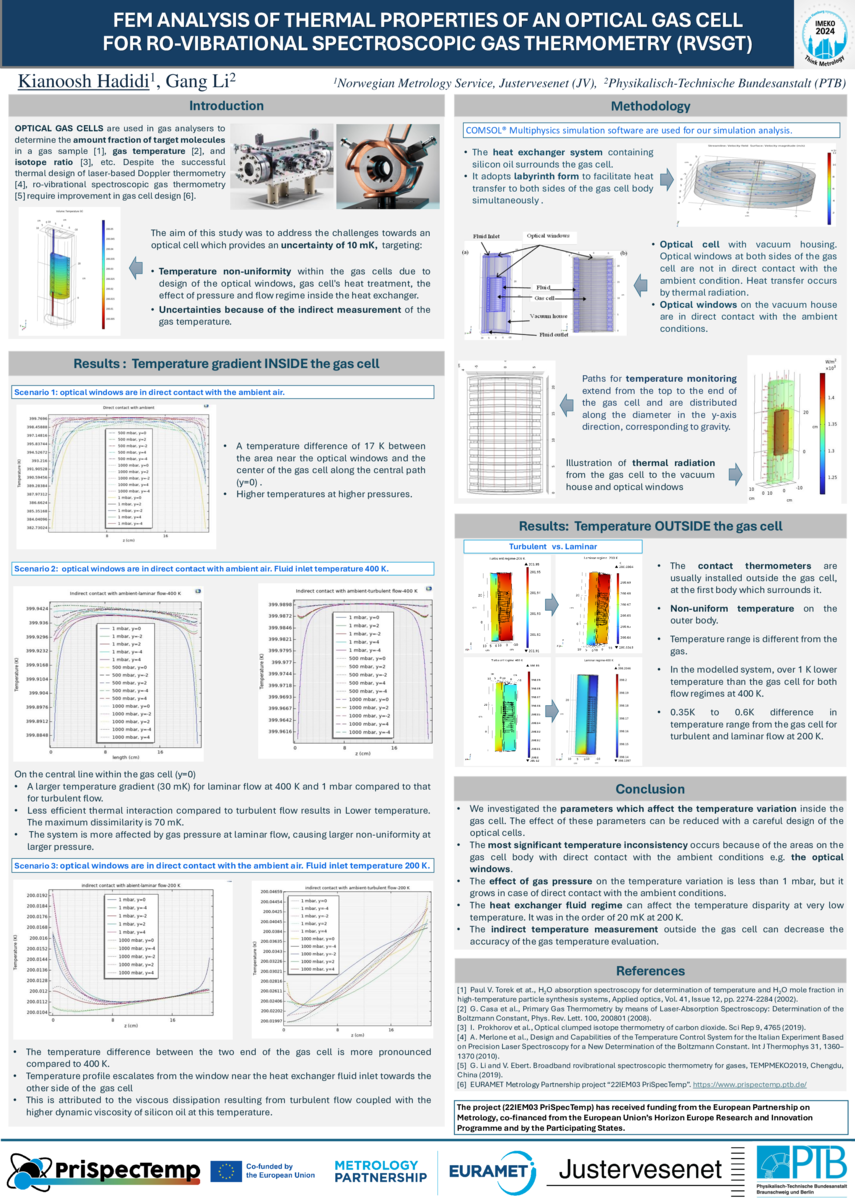
JV presented the FEM ANALYSIS OF THERMAL PROPERTIES OF AN OPTICAL GAS CELL FOR RO-VIBRATIONAL SPECTROSCOPIC GAS THERMOMETRY (RVSGT) at the IMEKO World Congress in Hamburg.
https://www.imeko2024.org/home
Abstract:
We utilised Finite Element Method (FEM) to analyse the thermal behaviour of newly designed optical gas cells. we have investigated the impact of gas pressure, the design of the optical windows, thermal radiation, gas pressure and the flow regime inside the heat exchanger on the temperature gradient within the spectroscopic gas cells. Considering practical spectroscopic measurement conditions, the simulation covered wide ranges of pressure and temperature, from 1 mbar to 1000 mbar, and from 200 K to 400 K, respectively. The results of the FEM analysis highlight the significance of the design of optical windows, including the size and isolation, in maintaining gas thermodynamic stability and homogeneity. Moreover, the simulation demonstrates how temperature profiles vary in different conditions and how energy dissipation from fluid flow affects gas temperature. Additionally, the study emphasises the importance of the installation place of temperature sensors for accurate temperature measurement. The findings of this research aim to provide valuable insights for the future design of optical gas cells.
The Poster is published in the PTB-OAR: https://oar.ptb.de/resources/show/10.7795/810.20240911B
PriSpecTemp project and CCQM-GAWG Pilot study on CO spectral data
EMN Climate and Ocean Observation Annual General Meeting 2024, June 2024, Paris
Project coordinator Dr. Gang Li on behalf of the consortium has updated the EMN-COO on the PriSpecTemp project and relevant activities at CCQM at the EMN AGM 2024 hosted by LNE.
Comb-locked cavity ring-down spectroscopy: combining high precision with ultra-high detection sensitivity in molecular interrogation
2025
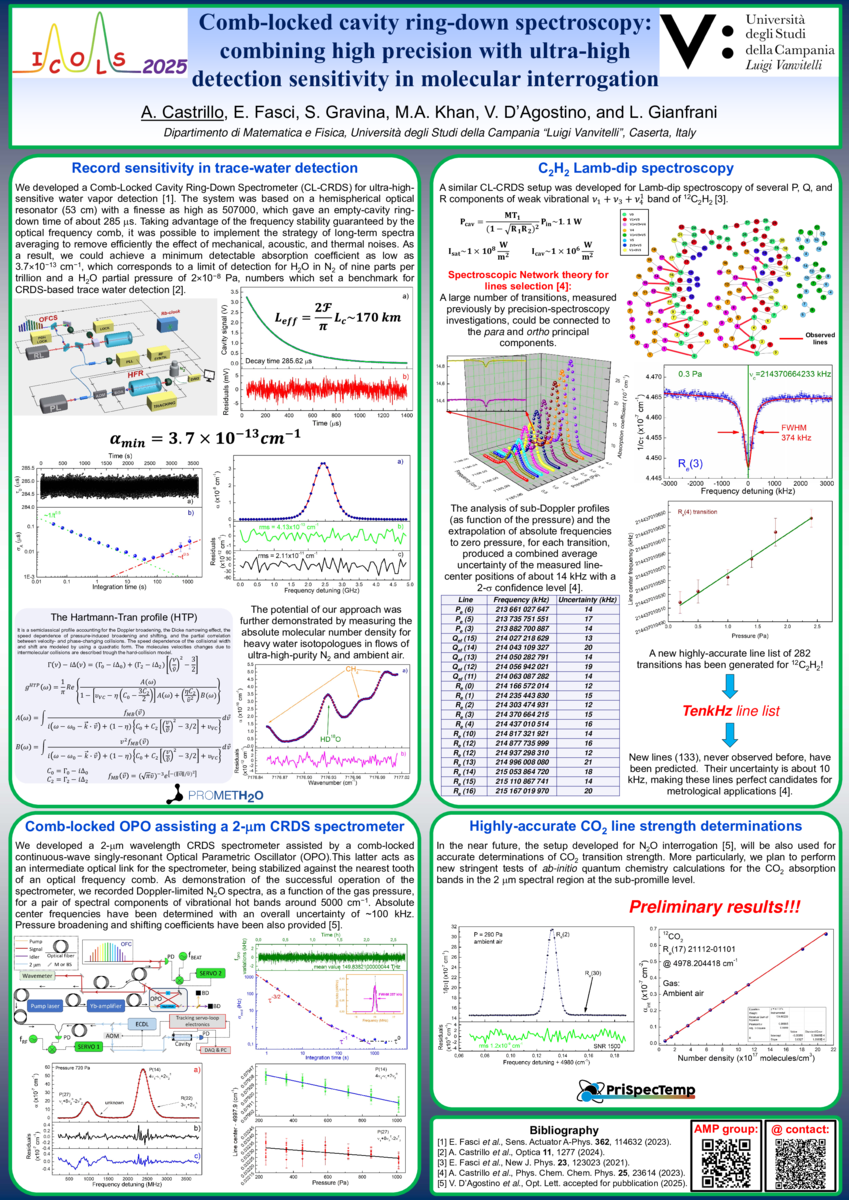
UniCampania has developed a novel spectroscopy technique setting new benchmarks for ultra-sensitive molecular analysis. Their work on comb-locked cavity ring-down spectroscopy (CL-CRDS) will be presented as a poster at the 2025 International Conference on Laser Spectroscopy (ICOLS) https://www.icols2025.it/.
Key Achievements:
Unprecedented Sensitivity: Detected water vapor in ultra-pure nitrogen gas down to 9 parts per trillion (ppt), equivalent to a partial pressure of just 2×10−102×10−10 mbar. Achieved a record-breaking absorption coefficient of 3.7×10−133.7×10⁻¹³ cm−1−1 using a high-finesse optical cavity (finesse > 500,000).
-
Rare Isotope Detection: Identified trace isotopologues like HD1616O and HD1818O in ambient air—molecules critical for climate and geochemical studies.
-
Metrology-Grade Precision: Measured sub-Doppler profiles of acetylene (C22H22) transitions with 7 kHz uncertainty at line centers. Validated quantum chemistry models for CO22 and N22O using a new 2-µm CL-CRDS spectrometer